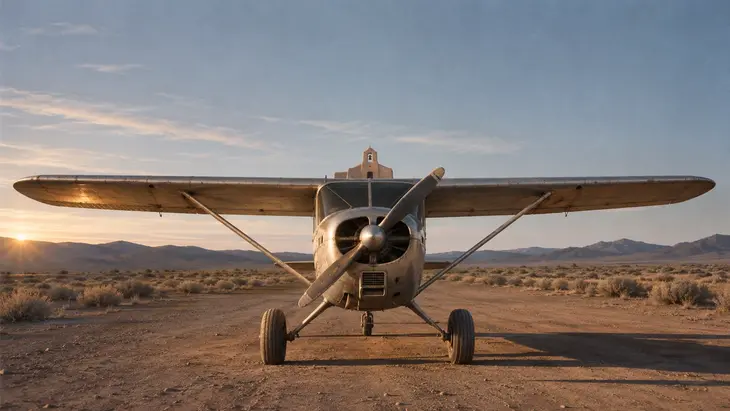
Flying Padre follows priest Fred Stadtmueller over two days as he uses a small plane to serve scattered communities in New Mexico. Kubrick’s short film combines religious services, everyday situations and an urgent medical transfer.
The priest, his territory and the episodes
Father Stadtmueller runs his work from a rural parish and travels by air to reach places separated by long distances. The film shows him at ceremonies and local gatherings, as well as responding to an emergency that requires a sick baby to be taken to an ambulance. The small plane therefore has a practical role in his pastoral work; it is not just a technical curiosity.
The story spans two days and is organised into episodes that show different aspects of the priest’s service. Fred Stadtmueller and his route explains this structure; the analysis of the small plane focuses on distances and access to the region, while the transfer sequence considers how the urgency is constructed without assuming that everything filmed was spontaneous.
A short documentary from Kubrick’s early career
Released in 1951 and associated with RKO’s short-film circuit, Flying Padre continues Kubrick’s exploration of the human-interest portrait that he had developed with Day of the Fight. A narrator and music guide the journey, in which images of travel, ceremonies and domestic life have to fit into just a few minutes.
The analysis of camera, sound and format presents these elements without attributing credits that are not documented. The portrayal of the community allows its ceremonies and gatherings with children to be examined from the perspective of those who appear in the documentary, avoiding the use of a nine-minute film as a general description of all rural communities in New Mexico.