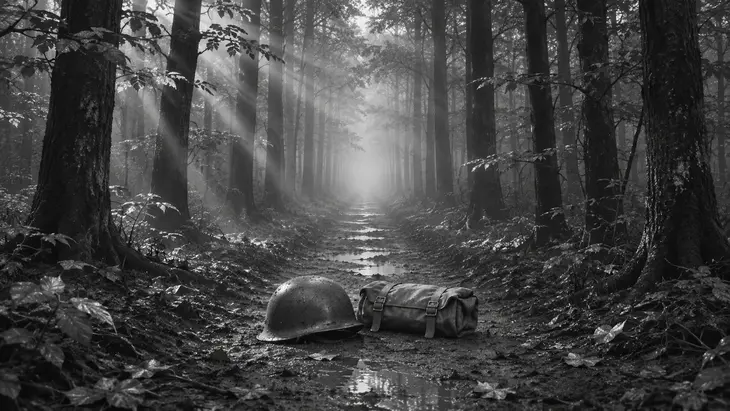
Fear and Desire, known in Spanish as Miedo y deseo, is Stanley Kubrick’s first feature film as a director. Four soldiers are stranded in enemy territory, with no country or war identified; the story combines survival, violence and doubled identities.
Cast, premise and structure
Released commercially in 1953 and presented earlier in Venice under the title Shape of Fear, the film was written by Howard Sackler and directed, photographed and edited by Kubrick. It stars Kenneth Harp as Lieutenant Corby, Frank Silvera as Mac, Paul Mazursky as Sidney and Steve Coit as Fletcher. Virginia Leith plays a young woman whom the patrol encounters on its journey. The absence of a specific historical war is part of the film’s presentation.
The group tries to return to its own lines after being stranded in a forest. A series of movements, violent encounters and decisions progressively separates the members of the patrol. The river and the raft provide a sense of spatial orientation, while the enemy post focuses another strand of action. The film can be described through these episodes and their transitions without imposing a rigid three-act division or reducing its entire structure to a pre-existing formula.
Characters, violence and mise-en-scène
The soldiers’ map and their doubles explains the hierarchies and the use of the same actors in opposing roles. The captive woman scene calls for a critical reading of power, violence and point of view; it cannot be treated as a mere illustration of an abstract idea about desire. The war without a country develops the allegorical framework, while the ending explained addresses the characters’ fate, with a spoiler warning.
The depiction of violence shifts between encounters and reflects choices in framing and editing. Gender relations, too, call for a distinction between scenes, positions of power and the voices that can or cannot speak. The cinematography and editing examine these techniques; the music and voices explore the relationship between commentary, interiority and Gerald Fried’s score. The guide provides context and points to those readings without replacing them.
Filming, release and versions
The feature was made with a small crew and limited resources. The production history covers writing, financing, locations and post-production. When considering its release, it is useful to distinguish the first public presentation in 1952, the commercial release in 1953, the reviews it received and the director’s later judgement of his work. Revisions and restorations have resulted in different running times: no single figure is enough to identify an edit without comparing materials.
Age classifications depend on the territory and the edition consulted. Likewise, the fact that Kubrick criticised the film or that different edits exist does not in itself prove institutional censorship. A festival screening does not automatically amount to an award or nomination either. Such details should be documented with the date, organisation and version when used to describe the film.