Dr. Strangelove or: How I Learned to Stop Worrying and Love the Bomb, directed by Stanley Kubrick and released in 1964, imagines a nuclear crisis triggered by the unilateral decision of an American general. The black comedy moves between an air force base, a bomber and the War Room.
A fictional crisis of orders and communications
General Jack D. Ripper sets an attack against the Soviet Union in motion, creating a situation that the American president and his advisers try to stop. The story distributes information across Burpelson Air Force Base, a B-52 carrying out orders, and the War Room, where a response is debated. Each space has its own language and pace. The satire emerges when people capable of handling complex procedures cannot control the consequences of their decisions. The film should not be taken as a literal reconstruction of historical military systems: its protocols belong to a fiction that uses recognisable elements of the Cold War.
Peter Sellers plays three characters: Group Captain Lionel Mandrake, President Merkin Muffley and Dr Strangelove. Sterling Hayden portrays Ripper, George C. Scott plays General Buck Turgidson, and Slim Pickens plays Major Kong, the bomber's commander. The cast allows us to compare different forms of authority: the commander who starts the crisis, the subordinate who tries to correct it, the president who needs information, and the specialists who turn disaster into a calculation. The article on Ripper and his paranoia explores the problem of delegated authority, while the recovery of the code by Mandrake follows a specific rescue sequence.
Spaces, bodies and the tone of the satire
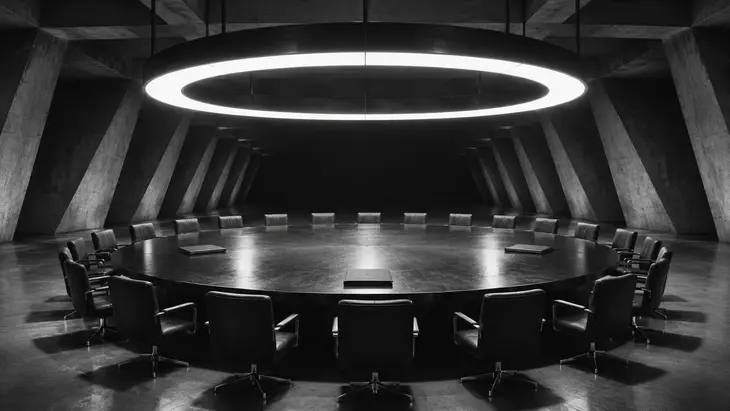
The War Room, designed by Ken Adam, is arranged around a circular table beneath high-contrast lighting. Its size, entrances and the positioning of its occupants make a hierarchy visible, but do not ensure sound decisions. The analysis of the War Room examines this architecture on screen, while studies of the Big Board and cinematography explore its components separately. At the base, Ripper and Mandrake's confinement creates another power dynamic; inside the B-52, duties are divided among crew members who believe they are carrying out a legitimate mission. The shifts between these settings prevent the film from being reduced to a single location.
The humour comes from the gap between professional language and the outcome of actions. Statistics, procedures and safety formulas are discussed as catastrophe approaches. Scott's gestures, Sellers' courtesy and Pickens' Western style also play a part. The film contains sexual allusions and gives women a very limited presence in decision-making spaces. These aspects can be read as part of its satire of institutional masculinity, but each observation needs to be supported by identified scenes. Political interpretations do not replace narrative facts or turn a gag into a historical account of how a government operates.
Writing, music and production documents
The screenplay is based on Peter George's novel Red Alert and credits Stanley Kubrick, George and Terry Southern. The shift from suspense to comedy was a writing transformation that should be distinguished from the material shot and the scenes ultimately cut. Anthony Harvey is credited as editor, Gilbert Taylor as cinematographer, Ken Adam as production designer and Laurie Johnson as composer. The main titles are credited to Pablo Ferro. The adaptation of Red Alert and Ferro's title design offer ways to study two different contributions without confusing the screenplay, filming and graphic presentation.
The music alternates between material with a military character and an ending associated with the song “We'll Meet Again”. The contrast between a familiar tune and images of destruction changes the tone of the conclusion. The doomsday machine presents the fictional logic of deterrence and secrecy, while articles on the final explosions and the B-52 music examine how they are realised audiovisually. The 1964 reception, institutional response and classification records belong to different documents: no negative review proves censorship, and no opening notice confirms military approval of the procedures depicted.
The film also circulates under alternative Spanish titles, including ¿Teléfono rojo? Volamos hacia Moscú. These names refer to the same 1964 work and do not require separate pages. This guide provides an introduction to the cast, narrative and main themes, leaving extended analyses of scenes, technique and production to specialist articles. The question that ties it all together is how an organisation that presents itself as rational can continue to function precisely while losing control of its most basic objective: preventing destruction.