Paths of Glory (1957) follows a French colonel who tries to protect his men after an offensive fails during the First World War. This guide introduces the conflict and offers pathways for exploring the characters and the film’s visual style.
The offensive and the decision to punish
A French general agrees to attack an almost inaccessible German position, known in the film as Ant Hill. Colonel Dax is given the order despite the obvious difficulties at the front. The attack fails, and the command looks for scapegoats among the soldiers. The story then shifts its focus from the violence of combat to the violence of decisions made far from the trenches. The drama is organised around the distance between those who give the orders and those who suffer the consequences.
Dax, played by Kirk Douglas, occupies an uncomfortable position: he is an officer, but he has a direct responsibility towards his men. His legal training enables him to defend three soldiers when they are accused. The trial is presented as a procedure that retains official forms while restricting the chances of proving what happened. The inquiry into the court-martial scene examines those decisions without turning them into a description of current military law.
The film uses characters of different ranks to represent the chain of command. Mireau applies direct pressure to the regiment; Broulard calculates the political consequences; the soldiers try to survive decisions they did not make. Among the accused, Paris, Arnaud and Ferol react in different ways. This contrast avoids treating the group as an undifferentiated mass. Colonel Dax’s journey develops his relationship with duty, defence and the limits of his interventions.
What the trenches and the palace show
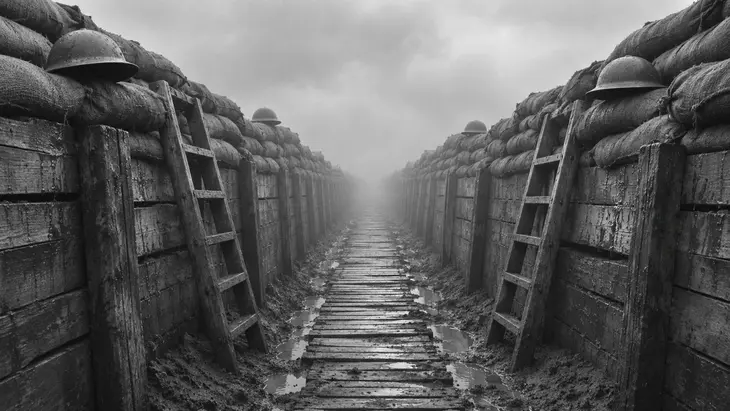
The spatial contrast helps us understand the inequality of power before any character explains it. The trenches are filled with noise, mud and exposed men; the command interiors offer space, order and distance. George Krause’s black-and-white cinematography organises movement and depth to make each figure’s position in the space visible. Dax’s movement through the trench examines one of the most precise sequences in this visual strategy.
Violence appears in different forms. The attack shows the physical exposure to enemy fire, while the command rooms turn momentous decisions into conversations that seem calm. The film does not suggest that all officers are identical or that all soldiers react to fear in the same way. Comparing behaviour, gestures and spaces allows us to analyse institutional inequality without automatically assigning every character a fixed philosophical meaning.
The social world of the story is dominated by men in uniform. Women have a particular place in the closing scene, when a young German woman sings to French soldiers. For a few moments, that scene changes how the enemy is seen, without putting an end to the war or military obligations. The song and the ending explain the conclusion in more detail than this introduction needs to give away.
Production context and ways to explore the film
Kubrick directed Paths of Glory in 1957, based on Humphrey Cobb’s novel. Stanley Kubrick, Calder Willingham and Jim Thompson are credited with the screenplay; James B. Harris produced the film. It was shot in Germany and starred Kirk Douglas. Its release history varied between countries due to diplomatic and military objections, an issue that should be distinguished from the story’s content.
The most useful way to explore the film depends on the question: the characters offer a way to study command and individual resistance; the attack and trial help trace the mechanics of punishment; the audiovisual form explains how space, waiting and violence are perceived. The film invites readings about war, justice, obedience and solidarity, but none requires turning every scene into an illustration of a single idea. Its power comes from precise situations and contradictions that remain unresolved.