A table can separate those who make decisions from those who obey. A uniform brings a group together without erasing its ranks. The materials in a shot contribute to the action, not just its appearance.
Spaces that shape movement and decisions
The War Room in Dr. Strangelove gathers its participants around a table and in front of representations of a situation unfolding far away. The Overlook allows people to move through corridors and rooms whose spaciousness does not guarantee safety. The architecture and set design can be compared by considering these functions: who occupies the centre, who has to cross a space and which areas remain beyond their reach.
The distinction between a studio and an existing location answers a different question. A found building can also be modified, lit and fragmented for the camera; a set can facilitate very specific actions. Analysing sets and locations avoids treating these choices as a simple opposition between falsehood and authenticity. In both cases, a cinematic space is constructed through material and audiovisual decisions.
The work of Ken Adam helps place some of this work within an identifiable professional practice. It is worth distinguishing the viewer’s experience of moving through the completed space from the documents and accounts that explain its design. A floor plan, a sketch and a scene each offer different information, even when they refer to the same place.
Furniture and costume in relation
The arrangement of furniture determines distances that performers have to negotiate. Sitting down, standing up, walking around a table or waiting beside a bed are dramatic actions. An object can shape a conversation without becoming a secret clue. The useful question is what it allows people to do, and whom it gives comfort, exposure or the ability to move.
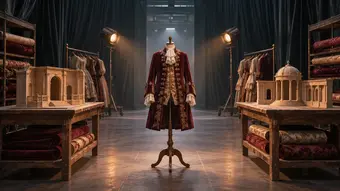
Costume design plays a different role. The clothing in Barry Lyndon places the characters within social conventions that require learning and resources. Military uniforms make it easier to recognise affiliations and internal differences. In Eyes Wide Shut, the relationship between clothing, face and access changes according to the situation. These uses do not all express the same idea of identity.
Considering fabric, silhouette and movement alongside light avoids isolating a costume as if it were a catalogue photograph. A garment shares the shot with bodies, furniture and backgrounds. Its function depends on that relationship and can change when a character moves to a different space or position.
Images that are also part of the set
The paintings in the rooms call for three things to be distinguished: the painting as a visible object, its possible relationship to the scene, and the documented authorship of the work. A similarity in colours does not prove an attribution, and recognising a painting does not mean the whole film must be read as an explanation of its meaning.
The pages in this section explore these distinctions through specific scenes. The approach starts with what the materials do within the shot and draws on credits or accounts when the question concerns how they were made. This makes it possible to study a shared visual construction without reducing it to an inventory of objects or assigning the same function to every detail.
Films discussed: Dr. Strangelove (1964), Barry Lyndon (1975), The Shining (1980) and Eyes Wide Shut (1999), directed by Stanley Kubrick.