2001: A Space Odyssey, released in 1968 and known in Spanish as 2001: Una odisea del espacio, spans several stages in the relationship between humanity, technology, and the unknown. This guide points readers to in-depth analyses of its imagery, characters, and production.
A Story Organized Around Major Leaps
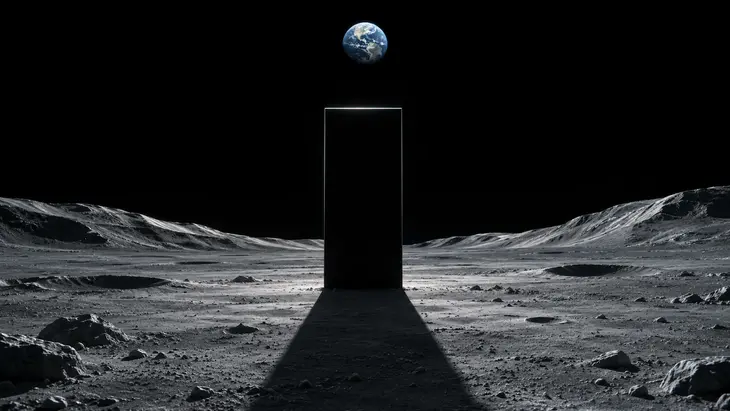
Stanley Kubrick directed 2001: A Space Odyssey, a science fiction film developed with Arthur C. Clarke. The story begins with groups of hominids, jumps to a future of space travel, and follows a mission to Jupiter aboard the Discovery. Encounters with precisely geometrical black objects known as monoliths connect stages that the film does not explain through an omniscient narrator. Shifts in time and scale are part of the experience. The Dawn of Man sequence allows us to study the origin of that structure without reducing the entire film to the meaning of a single cut.
The film provides information unevenly. The characters speak precisely about their tasks and keep the purpose of their missions secret. Viewers must connect actions, sounds, and images without being given a single interpretation of each event. The analysis of HAL 9000 examines the limits of knowledge and trust in artificial intelligence; the study of the ending focuses on questions about the room and the Star Child. This guide does not answer them in advance, because they belong to sequences with their own distinct questions.
Characters, Scenes, and Cinematic Language
Dave Bowman and Frank Poole are astronauts aboard the Discovery, while Heywood Floyd represents the administration of space exploration. Their everyday gestures and polite conversations contrast with the magnitude of events. HAL, the onboard computer, introduces a relationship of trust and surveillance that changes over the course of the mission. Tasks such as eating, resting, and moving around make the future seem livable before conflict emerges. The study of everyday routines develops this material dimension without treating every designed object as an accurate prediction.
Violence appears on very different scales: in the conflict between groups of hominids, in the threat facing the crew, and in survival procedures. The film does not assign the same meaning to each episode. The staging uses measured movements, shifts in orientation, and pauses that make the body a spatial reference point. The analysis of artificial gravity explains how the rotating sets contribute to that perception. The narrative locations include prehistoric landscapes, stations, lunar bases, and the interior of the Discovery; they should not be confused with the studios where the images were created.
Effects, Music, Writing, and Versions
The effects in 2001 combine different techniques. Front projection integrates studio action with photographic backgrounds; spaceship models create a sense of scale; and the Stargate uses optical techniques and other visual materials. It is incorrect to attribute every shot to one person or one device. The study of front projection and the technical articles distinguish these processes. The music also works through contrasts: Richard Strauss, Johann Strauss II, and György Ligeti serve different functions. The article about the two Strausses clears up a common confusion between the composers.
Kubrick and Clarke developed the film and the novel in dialogue with each other, but the two works should be read separately. The history of their collaborative writing distinguishes the earlier stories, the published material, and the released cut. Editions, formats, and ratings require identifying the territory, date, and print: a change in running time or a critical review does not by itself prove censorship. This guide offers ways to explore the film, not a catalog of commercial releases or an all-encompassing interpretation. The film can be revisited by focusing in turn on the characters, the material construction of its images, and the relationship between what it shows and what it leaves unexplained.