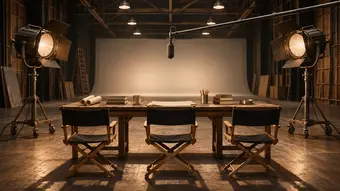
A courtroom, a spaceship, and a living room can organize power relationships in different ways. This guide connects dramatic questions with the choices in image, sound, and performance that make them observable.
What happens between the characters and how we come to know it
The themes and conflicts offer a comparative starting point: authority, desire, responsibility, and social belonging appear in different films, but they do not amount to a single philosophy voiced by all their characters. Dax debates a military decision from the standpoint of his professional role; Bill Harford tries to find his bearings through the prestige of his own. The similarities allow us to pose a question, while the differences keep us from assuming the answer is the same.
The narrative, screenplay, and adaptation examine how information is distributed. A character’s voice can explain and conceal at the same time. A narrator may foreshadow an outcome, while a scene lets us recognize a detail the protagonist doesn’t know. Comparing these techniques means separating the story’s information from the form and timing through which it is communicated.
The filmography of Kubrick preserves the context of each work. The comparisons in this section don’t replace individual analyses; they select situations to examine a shared mechanism and its variations. A visual or thematic resemblance also doesn’t, by itself, prove historical influence or an intention declared by the director.
Image, sound, and objects reshape a relationship
The cinematography, camera, and effects make it possible to study distance, movement, and visibility. Following a character and observing them from afar don’t direct attention in the same way. An orderly composition can make a hierarchy legible, but it can also reveal a fragility that order doesn’t eliminate. Form must be connected to what happens, rather than treated as a decorative signature in its own right.
The music, voices, and sound design add another structure to the experience. A song can contradict the gravity of a situation; a calm voice can accompany a threat; silence can leave a gesture without an immediate explanation. The question isn’t only what piece is playing, but what relationship it establishes with the images and with the information available.
The sets, objects, and costumes place characters within material possibilities. A door can restrict access; a table can distribute authority; a garment can make recognition easier or harder. The Overlook, a family home, and a military space aren’t equivalent just because they’re filmed precisely. Each makes certain actions possible and blocks others.
Working within a genre doesn’t mean repeating a formula
The direction of actors and staging examines bodies, voices, and responses. Hartman’s volume, the reserve of certain Barry Lyndon characters, and Sellers’s shifts in tone create different forms of presence. They can’t be reduced to a universal idea of detached acting or inferred solely from the number of takes attributed to a production.
The film genres offer expectations that films can use and modify. A war story invites us to expect a mission and an enemy; satire changes how we recognize authority; horror makes the relationship between space and threat uncertain. Studying these conventions doesn’t require treating every film as an absolute break with everything that came before.
The cinephilia, influence, and reception adds documents for investigating historical relationships and other viewers’ responses. Here, it’s important to distinguish a perceived affinity from a reference acknowledged by a participant. In formal analyses, the approach remains concrete: describe the scene, propose an interpretation, and check which elements support it or what alternatives it leaves open.
References for comparison: Stanley Kubrick, Paths of Glory (1957), Dr. Strangelove (1964), 2001: A Space Odyssey (1968), Barry Lyndon (1975), The Shining (1980), Full Metal Jacket (1987), and Eyes Wide Shut (1999). The thematic and formal connections are critical interpretations, not automatic attributions of authorial intent.