Released in 1971 and based on Anthony Burgess’s novel, A Clockwork Orange follows Alex amid his group’s violence and institutional attempts to change his behavior. This guide brings together focused studies of the film.
The film and its central questions
Stanley Kubrick directed A Clockwork Orange, based on Anthony Burgess’s novel. Malcolm McDowell plays Alex, a young man who commits acts of violence with his companions and, after being imprisoned, is selected for a fictional conditioning procedure. The film connects his choices with the response of institutions seeking to control behavior. This premise makes it possible to study the protagonist without justifying his assaults and to examine the state’s measures without treating them as real clinical solutions.
The trajectory of Alex presents the coexistence of musical sensitivity, a taste for objects, and the capacity to harm others. The Ludovico method develops the problem of choice when a behavior is physically prevented. To understand how the procedure is represented, the films projected during treatment have their own formal analysis. These approaches do not address the same question: one focuses on the character, another on the fictional device, and a third on the relationship between screen, sound, and gaze.
The narrative uses a group language called Nadsat, a protagonist’s voice that shapes the viewer’s closeness to him, and a structure of returns that shifts the characters’ power. The film cannot be reduced to a simple division into three acts without discussing its episodes and symmetries. Nor does its stylized violence amount to an invitation to admire Alex’s actions. It is useful to distinguish narrative identification, aesthetic experience, and moral judgment.
Spaces, music, and bodies in the mise-en-scène
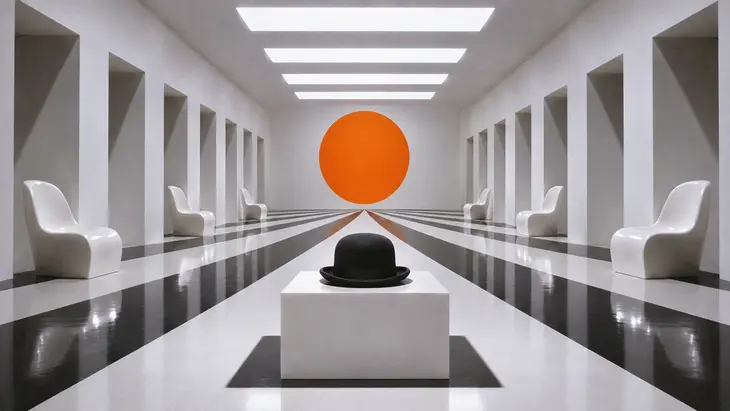
The film combines existing architecture, carefully designed interiors, consumer goods, and recognizable costumes. The Korova Milkbar introduces the group through a composition in which the furniture turns human figures into objects. The homes and institutions later change Alex’s relationship with space: he may feel that he owns a room and then discover that he has lost it. The study of Alexander’s house examines one specific interior; the analysis of art and objects connects different settings. A general guide should point readers toward these approaches without replacing their location and design studies.
Alex’s white clothes, bowler hat, and asymmetrical makeup form a visual identity whose meaning shifts when compared with institutional uniforms. Gestures, postures, and camera proximity also contribute to this construction. The work of Malcolm McDowell makes it possible to distinguish acting choices from the traits of the fictional character. Aspect ratio, lighting, and changes in speed should be described with reference to specific scenes; not every composition follows the same formal rule.
Music introduces decisive contrasts. Beethoven is first linked to Alex’s pleasure and later to conditioning. Wendy Carlos contributes electronic treatments that coexist with other recordings. The work of Wendy Carlos distinguishes what is heard in the film from what was released on records. The return of Singin’ in the Rain shows how a song can connect two very different moments. No piece of music has a fixed meaning apart from the image and the situation in which it is heard.
Adaptation, circulation, and ways to keep reading
The relationship with Burgess calls for distinguishing the film’s ending from the editions of the novel. The chapter 21 and the ending bring together a comparison that should not be oversimplified as an unqualified opposition between author and director. There are also unfilmed adaptation proposals and promotional materials that belong to the production history, not the plot. The Burgess screenplay and the Philip Castle poster offer two different kinds of document for study.
The film’s circulation in Britain has a specific history: its initial classification, its withdrawal in 1973, and its return to theaters in 1999. The article on the UK withdrawal distinguishes this sequence from classification decisions in other countries. Reports about controversies, version changes, and re-releases require dates and territories. A British classification should not be applied to every market, nor should the fiction be used as evidence of a causal link between a film and real-world crimes.
To find your way through A Clockwork Orange, it helps to choose a specific question. The study of Alex and the institutions is useful for discussing responsibility and choice; scene analysis shows how the camera and sound organize the experience; and work on music, architecture, and objects examines material choices. The 1971 film remains a unified work, but each of these approaches requires different evidence. This page brings together starting points and leaves the details to the articles devoted to them.