Full Metal Jacket follows Joker from Marine boot camp to his work as a military journalist and his participation in combat. The film connects these experiences without turning them into a smooth or exemplary personal journey.
The Film and Its Ways of Entering the War
Released in 1987, Full Metal Jacket is Stanley Kubrick’s film. It is known in Spain as La chaqueta metálica. In Spanish-speaking Latin America, the titles Cara de guerra and Nacido para matar are also used. These titles alone do not indicate a different cut: to establish differences between copies, check their content, language, and edition—not just the name on the poster.
The story centers on Joker, played by Matthew Modine. His journey connects the training of a group of recruits, the production of military news, and the experience of combat in Vietnam. The film does not tell the complete story of the war. Instead, it selects situations in which the characters learn to speak, obey, observe, and act within an institution that changes their relationship with violence.
R. Lee Ermey plays Sergeant Hartman, and Vincent D’Onofrio plays Leonard Lawrence, nicknamed Pyle. In the Vietnam section, Cowboy, played by Arliss Howard, and Animal Mother, played by Adam Baldwin, take on greater importance. Dorian Harewood plays Eightball, and Kevyn Major Howard plays Rafterman. The cast helps distinguish positions within a group; the guide to Joker as Observer and Participant follows the character’s progression through these stages.
The connection to Kubrick’s earlier war films can be explored through authority and the individual’s exposure to a military organization. Here, the focus shifts to the everyday construction of an identity and the language used to represent war. The tone allows for humor, unease, and abrupt changes in pace, without those shifts automatically turning violence into a celebration.
Training, Information, and Combat
The most visible division separates training on Parris Island from time in Vietnam. Within the second section, journalistic work and the platoon’s advance introduce different experiences. The Two-Part Structure and Several Movements helps explain these transitions without imposing a symmetry the film does not need to maintain. The setting and tasks change, but some ways of speaking and belonging to the group persist.
Discipline is presented through orders, repetition, and punishments that distribute responsibility among individuals and their fellow recruits. The group’s assault on Pyle shows violence produced within the group itself, not just directed at an outside enemy. The analysis of the Blanket Party examines the situation without turning it into a prescriptive account of real-world training or a clinical explanation of a character.
In Vietnam, newspapers, interviews, and cameras turn experience into material intended for circulation. The social critique can be traced in the gap between what is lived and what is considered publishable. The study of Journalism and Propaganda compares several instances of mediation. The film also invites an examination of who gets to speak and who appears mainly through the gaze of American soldiers.
The language of training uses sexual references and categories of masculinity to classify the recruits. Later, the presence of Vietnamese women introduces relationships involving money, the gaze, and power that should not be mistaken for a complete portrait of a society. The article on Sexual Language in Training explores this specific mechanism, distinguishing the characters’ vocabulary from an unsupported claim attributed to the director.
Image, Music, Adaptation, and Exhibition Conditions
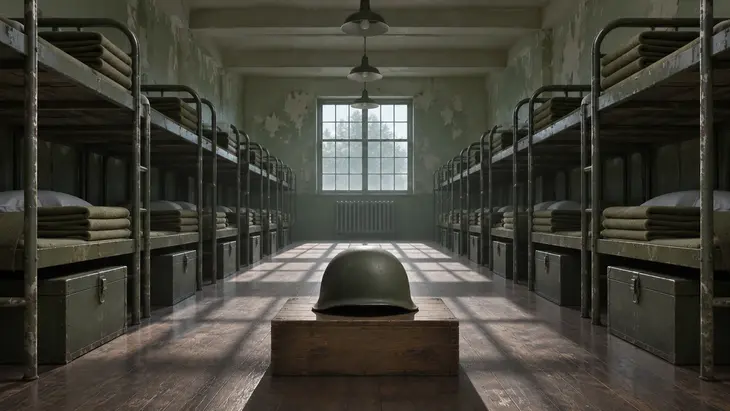
Douglas Milsome’s cinematography connects the geometry of the barracks with combat spaces where smoke, ruins, and depth make it difficult to find one’s bearings. The music combines preexisting songs with a score credited to Abigail Mead. Moving from a recognizable song to an instrumental texture can change the tone without interrupting the action. The Soundtrack Guide distinguishes these functions and avoids confusing the film with the track order of an album.
The literary source is The Short-Timers, a novel by Gustav Hasford published in 1979. The screenplay is credited to Kubrick, Michael Herr, and Hasford. The adaptation selects and reorganizes material, so it should not be presented as a literal retelling of a real case. The study of Novel, Screenplay, and Film makes it possible to compare choices without attributing every element to a single autobiographical experience.
The AFI catalog lists an R rating for the film’s 1987 U.S. release. That information applies to a specific territory and record, and does not replace ratings in other countries. The film contains sexual and offensive language, violence, and death. An age rating, a critical objection, and a censor’s intervention are different phenomena; none should automatically be inferred from the others. The ending analysis is reserved for its own page, which discusses the final section’s choices and includes plot spoilers.
References: Stanley Kubrick, Full Metal Jacket (1987), original English-language version; film credits. American Film Institute, AFI Catalog: Full Metal Jacket (1987). Spanish Institute of Cinematography and Audiovisual Arts, ICAA Catalog, file 101901: La chaqueta metálica.