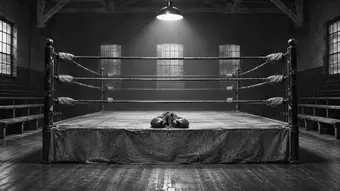
Killer's Kiss is a feature film by Stanley Kubrick released in 1955. It follows boxer Davey Gordon and Gloria Price, whose relationship is shaped by Vincent Rapallo's power in nighttime New York.
A Boxing Story and Urban Melodrama
Davey Gordon, played by Jamie Smith, tries to get his life back on track after a difficult athletic career. Gloria Price, played by Irene Kane, works at a dance hall connected to Vincent Rapallo, a character played by Frank Silvera. The film links Davey and Gloria's relationship to a situation of threat and dependence that turns a possible romance into a crime story. Boxing is part of the protagonist's life, but the story is about more than the outcome of a fight.
The city is part of the story: streets, windows, rooftops, and venues connect the paths of people who watch and follow one another. The black-and-white cinematography contributes to a sense of surveillance and isolation. The film also brings together narrated memories, a dance sequence, and a chase that culminates in a space filled with mannequins. These episodes have their own analyses and do not need to be reproduced in full in this general guide.
Characters, Violence, and Formal Techniques
The relationship between Davey, Gloria, and Rapallo allows us to examine the differences in power and the choices each of them makes without blaming Gloria for the violence she experiences. Costumes and characterization help establish settings and occupations, but they do not, on their own, define a fixed psychology. Physical contact, threats, and pursuits should be analyzed as concrete actions, not as decorative elements of a supposed criminal aesthetic.
The Fight Among the Mannequins examines the layout of the warehouse, the fragmentation of bodies and objects, and the rhythm of the confrontation. Other pages explore the ballet sequence, the use of New York City, the retrospective narration, and the production conditions. Together, they make it possible to distinguish formal questions from plot details and the material history of the shoot.
A Film Between Documentary and Crime Fiction
Killer's Kiss extends Kubrick's interest in real spaces and bodies in motion, though it organizes them within a fiction featuring actors, a screenplay, and dramatic construction. Boxing provides a thematic link to Day of the Fight, but the treatment of the characters and the city's role serve different narrative needs. The film can be placed within the director's development without treating it as a repeat of his documentaries.
This guide introduces the work and points readers toward specialized analyses. To study its structural changes, sound, or negotiations with censorship, it is necessary to consult documents and scenes covered on their own pages. Here, Killer's Kiss serves as an entry point to a film where crime, desire, and observation of the city intersect without being reduced to a single explanation.