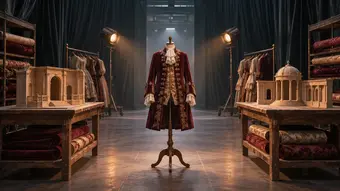
A criminal heist, a space mission, or a menacing house shapes what we expect from a movie. Kubrick works with these familiar contracts and changes how information, tension, and resolution are distributed.
From crime to the institutions that organize violence
The film noir of Killer's Kiss and The Killing connects the city, desire, and money with the difficulty of controlling the consequences. The characters prepare actions or look for a way out, but the two films do not distribute information in the same way. Comparing these approaches helps identify shared conventions without reducing the early works to simple exercises in a fixed style.
war brings together films that differ in scale, tone, and point of view. A military operation, a trial, and the training of a physical discipline do not offer the same experience. The uniform and the battlefield setting identify a context, but they are not enough to explain how a film constructs obedience, fear, or responsibility.
satire can operate within that context or turn its attention to other institutions. Dr. Strangelove pits solemn procedures against absurd consequences; A Clockwork Orange examines the political utility of controlling behavior. It is worth distinguishing the target of the criticism from the comic devices that make it perceptible.
Science fiction and horror: two ways of managing the unknown
science fiction makes it possible to ask what makes a body, a voice, or a behavior human. In 2001, the construction of technical routines coexists with experiences the characters cannot fully explain. The development of A.I. raises other questions about affection and creation, with an authorship distinction that must be preserved: the completed film was directed by Steven Spielberg.
horror creates a different relationship with uncertainty. The Shining turns familiar corridors into threatening situations; other works create unease without being classified entirely as horror movies. The length of a wait, the absence of an explanation, or a voice-over can cross genre boundaries.
Comparing these approaches requires attention to the actual experience. The presence of a machine does not turn every scene into a demonstration of technology, just as a violent image alone is not enough to define horror. What matters are the expectations a sequence sets up and how it allows or prevents them from being fulfilled.
History and documentary: different ways of organizing material
historical films distinguish material reconstruction from interpretations of the past. Spartacus and Barry Lyndon select conflicts and relationships through different narrative forms. Napoleon belongs to a different stage of production: its preparation documents should not be described as scenes from a completed film.
The three documentary shorts make it possible to compare observation, commentary, and commissioned work. A day in the life of a boxer, the work of a priest, and a presentation of a labor organization do not establish the same relationship with the people on screen. Nonfiction also selects and arranges.
These paths suggest comparisons based on questions and methods. A film can use devices from several genres, and the same convention can serve different purposes in different works. Classification is useful when it helps describe those choices, not when it replaces analysis with a single label.
Reference works: films directed by Stanley Kubrick; documentation of his unrealized projects; Steven Spielberg, A.I. Artificial Intelligence (2001).