Atraco perfecto, The Killing, is the 1956 feature film in which Stanley Kubrick follows a group organised to rob the takings at a racecourse. Its narrative rearranges the same moments from several perspectives, turning the group’s coordination into a source of suspense and irony.
Johnny Clay’s plan and the characters
Johnny Clay, played by Sterling Hayden, brings together accomplices connected to the racecourse and hires others to create distractions. Marvin Unger offers support and trust; Mike O’Reilly, Randy Kennan and George Peatty occupy different positions within an alliance shaped by personal needs. Fay, Johnny’s partner, and Sherry Peatty also matter beyond the immediate execution: Sherry’s relationship with George allows information to leave the group. Analysing the heist plan explains how dependencies work within the story without treating it as an operational manual.
The film uses this range of characters to show their incompatible expectations about money. Johnny is thinking of a fresh start with Fay; others hope to ease debts or family difficulties. Decisions made away from the racecourse affect the execution and what happens afterwards. The relationship between George and Sherry and the comparison between Fay, Sherry and Ruth offer ways to explore these perspectives without reducing the women to a list of obstacles for the group.
A story that goes back to change what we know
The Killing presents events out of strict chronological order and uses a narrator to establish times and movements. The shifts in time do not mean that the same events happen again. Each return lets us observe a task or decision whose effect was not evident in the previous scene. The chronology explained distinguishes the order of presentation from the order of events, while the individual scenes retain their analysis of the bar fight, the race and the later confrontation between the participants.
Kubrick worked with cinematographer Lucien Ballard on images that contrast the activity of the racecourse with apartments, offices and meeting rooms. Camera movements, groups of people in cramped rooms, and the interplay of light and shadow help make the alliance’s trust and insecurity visible. Violence appears in concentrated episodes whose effects extend to characters who do not witness them. Age classifications depend on territory and cut; these scenes alone cannot establish a single rating applicable to every screening.
Adaptation, release and ways into the film
Atraco perfecto is based on Lionel White’s novel Clean Break. The production by James B. Harris, Kubrick’s screenplay and the dialogue credited to Jim Thompson help distinguish the roles within a collaborative project. The film circulated under other working titles and reached audiences in 1956 through United Artists. The existence of critical revisions or industry concerns about the edit should not be confused with an official ban in the absence of documentation. The adaptation and production themes are explored separately.
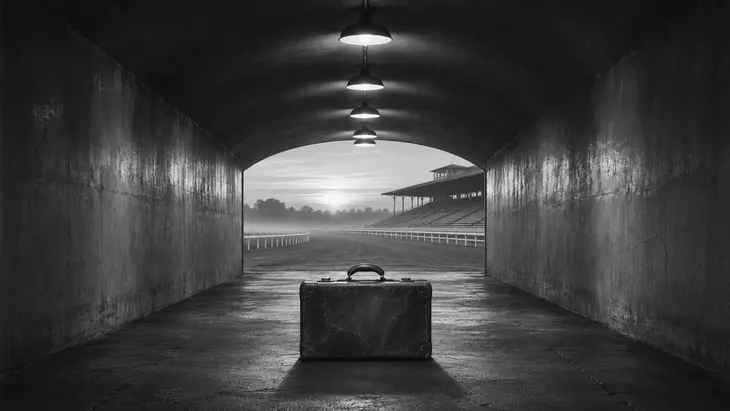
The film can be approached through the organisation of the heist, the relationships between partners or its temporal structure. A fourth entry point is the ending explained, where a suitcase and an accident make Johnny’s calculations useless; here, it is enough to note that the ending tests the security the plan seemed to promise. Atraco perfecto combines a crime story with an examination of the limits of control and the price of trusting people who do not share the same reasons for taking part.