2001: A Space Odyssey, released in 1968 and known in Spanish as 2001: Una odisea del espacio, explores several stages in the relationship between humanity, technology and the unknown. This guide points readers to detailed analyses of its imagery, characters and production.
A story structured around great leaps
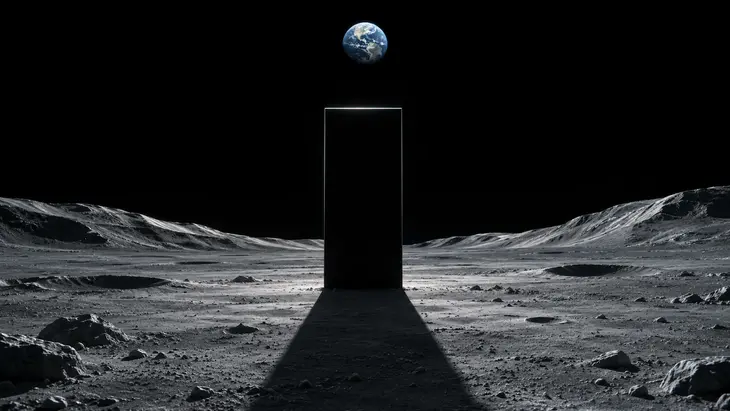
Stanley Kubrick directed 2001: A Space Odyssey, a science-fiction film developed with Arthur C. Clarke. The story begins with groups of hominids, leaps to a future of space travel, and follows a mission to Jupiter aboard the Discovery. Encounters with black objects of precise geometry, known as monoliths, connect stages that the film does not explain through an omniscient narrator. Changes in time and scale are part of the experience. The Dawn of Man sequence helps explore the origins of this structure without reducing the entire film to the meaning of a single cut.
The film provides information unevenly. The characters speak precisely about their tasks and keep the purpose of their missions secret. Viewers must connect actions, sounds and images without being given a single interpretation of each event. The analysis of HAL 9000 explores the limits of knowledge and trust in artificial intelligence; the study of the ending focuses on questions about the room and the Star Child. This guide does not attempt to answer them in advance, as they belong to sequences with their own distinct concerns.
Characters, scenes and cinematic language
Dave Bowman and Frank Poole are astronauts aboard the Discovery, while Heywood Floyd represents the administration of space exploration. Their everyday gestures and the courtesy of their conversations contrast with the scale of events. HAL, the onboard computer, introduces a relationship of trust and surveillance that changes over the course of the mission. Tasks such as eating, resting and moving around make the future seem habitable before the conflict begins. The study of everyday routines explores this material dimension without treating every design object as an accurate prediction.
Violence appears on very different scales: in the conflict between groups of hominids, in the threat faced by the crew, and in survival procedures. The film does not give each episode the same meaning. Its staging uses measured movements, changes in orientation and pauses that make the body a spatial reference point. The analysis of artificial gravity explains how the rotating sets contribute to this perception. The story's locations include prehistoric landscapes, stations, lunar bases and the interior of the Discovery; these should not be confused with the studios where its images were created.
Effects, music, writing and versions
The effects in 2001 bring together different techniques. Front projection integrates studio action with photographic backgrounds; spaceship models create a sense of scale; the Stargate uses optical techniques and other visual materials. It is inaccurate to attribute every shot to a single person or device. The study of front projection and the technical articles distinguish between these processes. The music also works through contrasts: Richard Strauss, Johann Strauss II and György Ligeti serve different purposes. The article about the two Strausses clears up a common confusion between the composers.
Kubrick and Clarke developed the film and the novel in dialogue with one another, but the two works should be read separately. The history of their collaborative writing distinguishes between earlier stories, published material and the version released in cinemas. Editions, formats and classifications need to be identified by territory, date and print: a change in running time or a critical review does not, by itself, prove censorship. This guide offers reading pathways, not a catalogue of commercial releases or a complete interpretation. The film can be revisited by considering its characters, the material construction of its images, and the relationship between what it shows and what it leaves unexplained, in turn.