Released in 1971 and based on Anthony Burgess’s novel, A Clockwork Orange follows Alex as he moves between his group’s violence and institutional attempts to modify his behaviour. This guide brings together focused studies of the film.
The film and its central questions
Stanley Kubrick directed A Clockwork Orange, based on Anthony Burgess’s novel. Malcolm McDowell plays Alex, a young man who commits acts of violence with his companions and is selected for a fictional conditioning procedure after being imprisoned. The film connects his choices with the response of institutions seeking to control behaviour. This premise makes it possible to study the protagonist without justifying his attacks, and to examine the State’s measures without treating them as real clinical solutions.
The course of Alex’s life presents the coexistence of musical sensitivity, a taste for objects and the capacity to harm others. The Ludovico Technique develops the problem of choice when a person is physically prevented from behaving in a particular way. To understand how the procedure is represented, the films shown during the treatment have their own formal analysis. These approaches raise different questions: one focuses on the character, another on the fictional device, and another on the relationship between screen, sound and gaze.
The narrative uses a group language called Nadsat, a protagonist’s voice that shapes the viewer’s sense of closeness, and a structure of returns that shifts the characters’ power. The film cannot be reduced to a simple three-act division without considering its episodes and symmetries. Nor is its stylised violence an invitation to admire Alex’s actions. It is useful to distinguish narrative identification, aesthetic experience and moral judgement.
Spaces, music and bodies in the mise-en-scène
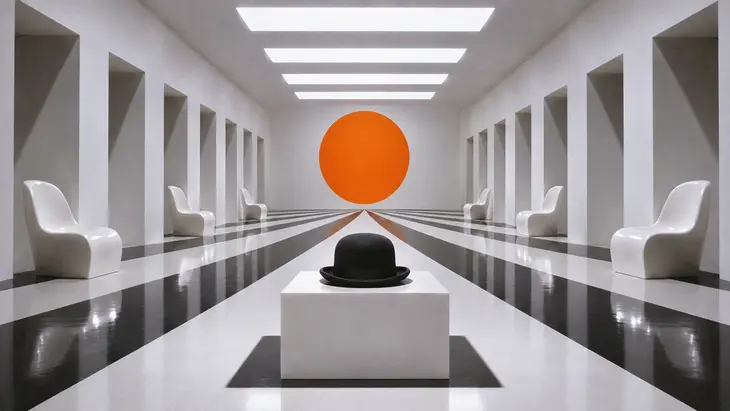
The film combines existing architecture, carefully designed interiors, consumer goods and distinctive costumes. The Korova Milkbar introduces the group through a composition in which the furniture turns human figures into objects. The homes and institutions later alter Alex’s relationship with space: he may feel that he owns a room, then discover that he has lost that place. The study of Alexander’s house examines a particular interior; the analysis of art and objects connects different settings. A general guide should point to these approaches without replacing their studies of locations and design.
Alex’s white clothes, bowler hat and asymmetrical make-up form a visual identity that takes on a different meaning when compared with institutional uniforms. Gestures, postures and camera proximity also contribute to this construction. The performance by Malcolm McDowell helps distinguish acting choices from the traits of the fictional character. Aspect ratio, lighting and changes in speed should be described with reference to specific scenes; not every composition follows the same formal rule.
Music introduces decisive contrasts. Beethoven is associated first with Alex’s pleasure and later with conditioning. Wendy Carlos contributes electronic treatments that sit alongside other recordings. The work of Wendy Carlos distinguishes what is heard in the film from what was released on records. The return of Singin’ in the Rain shows how a song can connect two very different moments. No piece of music has a fixed meaning apart from the image and the situation in which it is heard.
Adaptation, circulation and ways to read further
The relationship with Burgess calls for a distinction between the film’s ending and the different editions of the novel. The Chapter 21 and the ending bring together a comparison that should not be simplified into an unqualified opposition between author and director. There are also unfilmed adaptation proposals and promotional materials, which belong to the production history rather than the plot. The Burgess’s screenplay and the poster by Philip Castle allow two different types of document to be studied.
The film’s circulation in Britain has a specific history: its initial classification, its withdrawal in 1973 and its return to cinemas in 1999. The article on the withdrawal in the UK distinguishes this sequence from classification decisions in other countries. Reports about controversies, version changes and re-releases require dates and territories. A British classification should not be applied to every market, nor should fiction be used as proof of a causal relationship between a film and real crimes.
To find your way into A Clockwork Orange, it helps to choose a specific question. The study of Alex and the institutions is useful for discussing responsibility and choice; scene analysis shows how camera and sound organise the experience; work on music, architecture and objects examines material choices. The 1971 film remains a unified work, but each of these approaches requires different evidence. This page brings together starting points and leaves the details to the articles devoted to them.