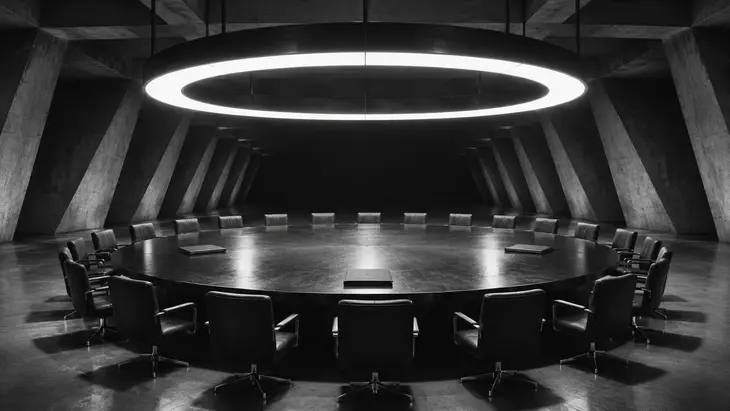
Dr. Strangelove or: How I Learned to Stop Worrying and Love the Bomb, directed by Stanley Kubrick and released in 1964, imagines a nuclear crisis set off by the unilateral decision of an American general. The black comedy alternates between an air base, a bomber and the War Room.
A fictional crisis of orders and communications
General Jack D. Ripper sets an attack against the Soviet Union in motion, creating a situation that the American president and his advisers try to stop. The story distributes information across Burpelson Air Force Base, a B-52 carrying out orders and the War Room, where the response is debated. Each space has its own language and pace. The satire emerges when people capable of managing complex procedures cannot control the consequences of their decisions. The film should not be taken as a literal reconstruction of historical military systems: its protocols belong to a work of fiction that uses recognisable elements of the Cold War.
Peter Sellers plays three characters: Group Captain Lionel Mandrake, President Merkin Muffley and Dr Strangelove. Sterling Hayden plays Ripper, George C. Scott plays General Buck Turgidson, and Slim Pickens plays Major Kong, the bomber's commander. The cast allows us to compare different forms of authority: the commander who starts the crisis, the subordinate who tries to correct it, the president who needs information and the specialists who turn disaster into calculations. The article on Ripper and his paranoia opens up the question of delegated authority, while the recovery of the code by Mandrake follows a specific rescue sequence.
Spaces, bodies and the tone of the satire
The War Room, designed by Ken Adam, is arranged around a circular table beneath high-contrast lighting. Its size, entrances and the arrangement of its occupants make a hierarchy visible, but do not guarantee sound decisions. The analysis of the War Room examines this on-screen architecture, while the studies of the Big Board and cinematography explore its components separately. At the base, Ripper and Mandrake's confinement creates another power dynamic; inside the B-52, tasks are divided among crew members who believe they are carrying out a legitimate mission. The alternation prevents the film from being reduced to a single setting.
The humour lies in the distance between professional language and the outcome of the actions. Statistics, procedures and safety formulas are discussed as catastrophe draws near. Scott's gestures, Sellers's courtesy and Pickens's Western-style delivery also play a part. The film contains sexual references and has a very limited female presence in decision-making spaces. These aspects can be read as part of its satire of institutional masculinity, but each observation needs to be supported by identified scenes. Political interpretations do not replace narrative facts or turn a gag into a historical account of how a government operates.
Writing, music and production documents
The screenplay is based on Peter George's novel Red Alert and credits Stanley Kubrick, George and Terry Southern. The shift from suspense to comedy was a writing transformation that should be distinguished from the footage shot and the scenes ultimately discarded. Anthony Harvey is credited as editor, Gilbert Taylor as cinematographer, Ken Adam as production designer and Laurie Johnson for the music. The main titles are credited to Pablo Ferro. The adaptation of Red Alert and Ferro's title design make it possible to study two different contributions without confusing the screenplay, filming and graphic presentation.
The music alternates between material with a military character and an ending associated with the song We'll Meet Again. The contrast between a familiar melody and images of destruction changes the tone of the ending. The Doomsday Machine explores the fictional logic of deterrence and secrecy, while the articles on the final explosions and the B-52 music analyse their audiovisual execution. The 1964 reception, the institutional response and the classification records belong to different documents: no negative review proves censorship, and no opening disclaimer confirms military approval of the procedures depicted.
The film also circulates under alternative Spanish titles, including ¿Teléfono rojo? Volamos hacia Moscú. These titles refer to the same 1964 film and do not require separate pages. This guide introduces the cast, narrative and main themes, while reserving detailed analyses of scenes, technique and production for specialist articles. The question that brings it all together is how an organisation that presents itself as rational can continue to function precisely while losing control of its most basic objective: preventing destruction.