Paths of Glory (1957) follows a French colonel who tries to protect his men after an offensive fails during the First World War. This guide introduces the conflict and offers routes for exploring its characters and visual style.
The offensive and the decision to punish
A French general agrees to attack an almost inaccessible German position, known in the film as Ant Hill. Colonel Dax is given the order despite the obvious difficulties at the front. The attack fails, and the command looks for soldiers to hold responsible. The story then shifts attention from the violence of combat to the violence of decisions made far from the trenches. The drama is built around the distance between those who give the orders and those who suffer the consequences.
Dax, played by Kirk Douglas, occupies an uncomfortable position: he is an officer, but also has a direct responsibility towards his men. His legal training enables him to defend three soldiers when they are accused. The trial is presented as a procedure that retains official forms while restricting the chances of proving what happened. The analysis of the court-martial scene examines these decisions without turning them into a description of current military law.
The film uses characters of different ranks to represent the chain of command. Mireau exerts direct pressure on the regiment; Broulard weighs the political consequences; the soldiers try to survive decisions they did not make. Among the accused, Paris, Arnaud and Ferol react in different ways. This contrast avoids treating the group as an indistinguishable mass. Colonel Dax's journey explores his relationship with duty, defence and the limits of his interventions.
What the trenches and the palace reveal
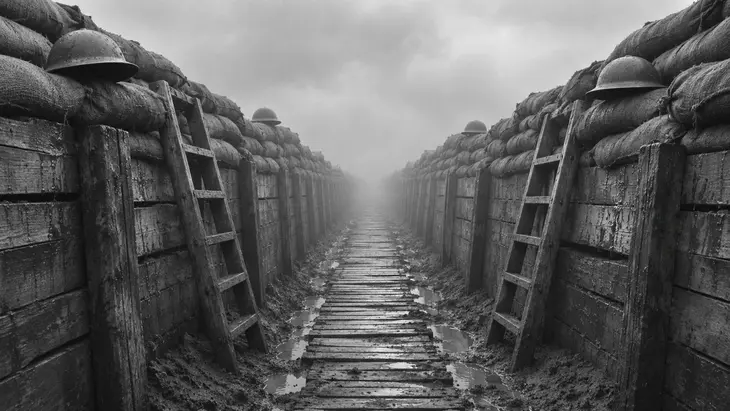
The contrast between settings makes the imbalance of power clear before any character explains it. The trenches are filled with noise and mud, with men exposed to danger; the command interiors offer space, order and distance. George Krause's black-and-white cinematography shapes movement and depth to make each figure's position in the space visible. Dax's movement through the trench examines one of the most precise sequences in this visual strategy.
Violence takes different forms. The attack shows physical exposure to enemy fire, while the command rooms turn grave decisions into conversations that appear calm. The film does not suggest that all officers are alike or that all soldiers respond to fear in the same way. Comparing behaviour, gestures and spaces makes it possible to analyse institutional inequality without automatically assigning a fixed philosophical meaning to every character.
The story's social world is dominated by men in uniform. Women take on a particular presence in the closing scenes, when a young German woman sings before French soldiers. For a few moments, this scene changes how the enemy is viewed, without ending the war or removing military obligations. The song and the ending explain the conclusion in greater detail than this introduction needs to reveal.
Production context and ways to explore the film
Kubrick directed Paths of Glory in 1957, adapting Humphrey Cobb's novel. Stanley Kubrick, Calder Willingham and Jim Thompson are credited with the screenplay; James B. Harris produced the film. It was shot in Germany and starred Kirk Douglas. Its release varied across countries because of diplomatic and military objections, an issue that should be distinguished from the story's content.
The most useful way to explore the film depends on the question: the characters help examine command and individual resistance; the attack and trial trace the mechanism of punishment; the audiovisual form shows how space, waiting and violence are experienced. The film invites readings about war, justice, obedience and solidarity, but none requires turning every scene into an illustration of a single idea. Its power comes from precise situations and contradictions that remain unresolved.