The Perfect Heist, The Killing, is the 1956 feature film in which Stanley Kubrick follows an organised group set on robbing the takings at a racecourse. Its narration rearranges the same moments from several perspectives, making the group's coordination a source of suspense and irony.
Johnny Clay's heist plan and the characters
Johnny Clay, played by Sterling Hayden, brings together associates connected to the racecourse and hires others to create distractions. Marvin Unger provides support and confidence; Mike O'Reilly, Randy Kennan and George Peatty occupy different positions within an alliance shaped by personal needs. Also important beyond the immediate execution are Fay, Johnny's partner, and Sherry Peatty, whose relationship with George allows information to leave the group. Analysis of the heist plan explains how dependencies work within the fiction without treating it as an operational manual.
The film uses this range of characters to show incompatible expectations about money. Johnny thinks of leaving with Fay; others hope to ease their debts or family troubles. Decisions made outside the racecourse affect the execution and what happens afterwards. The relationship between George and Sherry and the comparison between Fay, Sherry and Ruth allow us to explore these perspectives without reducing the women to a list of obstacles for the group.
A story that rewinds to change what we know
The Killing presents events out of strict chronological order and uses a narrator's voice to establish times and movements. Temporal repetition does not mean that the same events happen again. Each return allows us to observe a task or decision whose effect was not evident in the previous scene. The chronology explained distinguishes the order of presentation from the order of events, while the individual scenes retain the analysis of the bar fight, the race and the later confrontation among the participants.
Kubrick worked with cinematographer Lucien Ballard on images that contrast the activity at the racecourse with apartments, offices and meeting rooms. Camera movements, people gathered in cramped rooms, and the play of light and shadow make the alliance's trust and insecurity visible. Violence appears in concentrated episodes whose effects reach characters who do not witness them. Age ratings depend on the territory and edition; a single rating applicable to every screening cannot be inferred from these scenes.
Adaptation, release and ways to explore
The Perfect Heist is based on Lionel White's novel Clean Break. The production by James B. Harris, Kubrick's screenplay and the dialogue credited to Jim Thompson make it possible to distinguish the different roles within a collaborative project. The film circulated under other working titles and reached audiences in 1956 through United Artists. The existence of critical revisions or industry concerns about the edit should not be confused with an official ban without supporting documents. The themes of adaptation and production are explored separately.
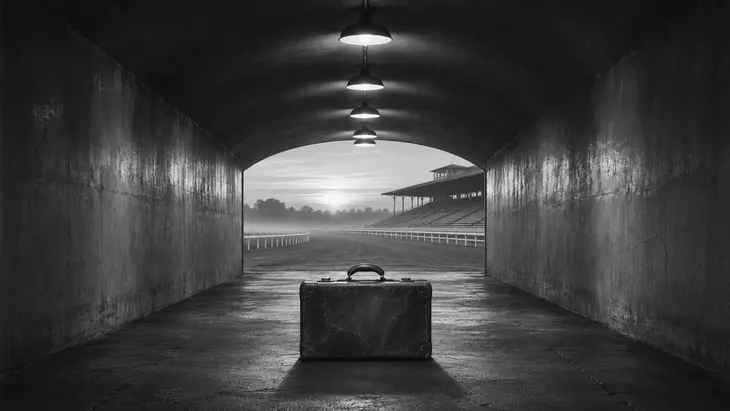
The film can be explored through the organisation of the heist, relationships between partners or its temporal structure. A fourth entry is the explanation of the ending, where a suitcase and an accident make Johnny's calculations worthless; here it is enough to note that the ending tests the security the plan seemed to promise. The Perfect Heist combines a crime story with an observation of the limits of control and the cost of trusting people who do not share the same reasons for taking part.