A table can separate those who make decisions from those who obey. A uniform brings a group together without erasing its ranks. The materials in a shot contribute to the action, not merely to its appearance.
Spaces that shape movement and decisions
The War Room in Dr. Strangelove brings its participants together around a table and in front of representations of a situation unfolding far away. The Overlook allows people to move through corridors and rooms whose spaciousness does not guarantee safety. Architecture and set design can be compared in terms of these functions: who occupies the centre, who has to cross a space and which areas remain beyond their reach.
The distinction between a studio and an existing location answers a different question. A building found for filming can also be altered, lit and broken up for the camera; a set can facilitate very specific actions. An analysis of sets and locations avoids treating these choices as a simple opposition between falseness and authenticity. In both cases, a cinematic space is constructed through material and audiovisual decisions.
The collaboration of Ken Adam helps place some of this work within an identifiable professional practice. It is useful to distinguish the viewer’s experience of moving through the finished space from the documents and accounts that explain its design. A floor plan, a sketch and a scene offer different kinds of information, even when they refer to the same place.
Furniture and costumes within a relationship
The arrangement of the furniture determines the distances that performers have to negotiate. Sitting down, standing up, walking around a table or waiting beside a bed are dramatic actions. An object can shape a conversation without thereby becoming a secret clue. The useful question is what it allows someone to do, and whom it gives comfort, visibility or the ability to move.
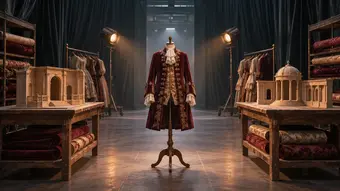
Costume design plays a different part. The clothing in Barry Lyndon places the characters within social conventions that require learning and resources. Military uniforms make it easier to recognise affiliations and internal differences. In Eyes Wide Shut, the relationship between clothing, face and access changes depending on the situation. These uses do not all express the same idea of identity.
Looking at fabric, silhouette and movement alongside the lighting keeps a costume from being isolated like a catalogue photograph. A garment shares the shot with bodies, furniture and backgrounds. Its function depends on this relationship and can change when the character moves to a different space or position.
Images that are also part of the set
The paintings displayed in the rooms call for three things to be distinguished: the painting as a visible object, its possible relationship to the scene, and the documented authorship of the work. A similarity in colours does not prove an attribution, and recognising a painting does not require reading the entire film as an explanation of its meaning.
The pages in this section explore these distinctions through specific scenes. The approach begins with what the materials do within the shot, and draws on credits or accounts when the question concerns how they were made. This makes it possible to study a shared visual construction without reducing it to an inventory of objects or assigning the same function to every detail.
Reference films: Dr. Strangelove (1964), Barry Lyndon (1975), The Shining (1980) and Eyes Wide Shut (1999), directed by Stanley Kubrick.