A.I. Artificial Intelligence was developed over many years by Stanley Kubrick and brought to the screen by Steven Spielberg. Its history calls for distinguishing the literary origins, development proposals, and decisions behind the film released in 2001.
A short story led to a much broader development
The starting point was Supertoys Last All Summer Long, Brian Aldiss’s story originally published in 1969. The relationship between an artificial child and a family offered a conflict about affection and recognition. The study of the original story helps separate that premise from the characters, journeys, and situations that emerged as the project expanded.
This was not a matter of adapting a lengthy novel into a shorter screenplay. The work had to build a more expansive narrative from a brief source. This difference helps explain why the writing of A.I. involved successive treatments, revisions, and collaborations rather than a single step from book to film.
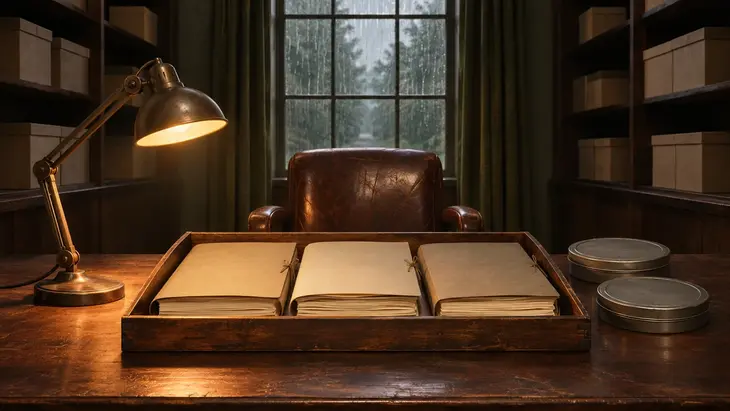
The archive preserves materials by Brian Aldiss, Ian Watson, and Sara Maitland, among other documents whose authorship is not always identified with the same degree of certainty. The final screen story credit goes to Watson; the screenplay credit goes to Spielberg. These credits identify responsibilities for the completed work without erasing the earlier development.
Designing a world and figuring out how to film it
The project had to make a childlike artificial character believable. This need affected both the portrayal and the organization of the work. The design and effects planned for A.I. distinguish conceptual drawings, production studies, and techniques actually used in the 2001 film.
Chris Baker, also known as Fangorn, was part of that continuity between development and production. However, the existence of earlier designs does not mean that all the feature film’s sets and effects can be attributed to Kubrick. The film had its own crew and decisions made during its production under Spielberg.
The materials on script development should not be read as images ready to film, either. A story proposal may call for a visual solution that is still open, and a drawing may prompt changes to the story. The relationship between writing and design was a working process, not a chain in which each stage was definitively completed before the next.
A continuity that does not erase Spielberg’s authorship
Spielberg directed A.I. and wrote the screenplay for the film released in 2001. Kubrick had spoken with him about making the film before Kubrick died in 1999. The relationship between the two on A.I. should be studied through accounts, materials, and credits—not through an intuitive division between supposedly cold scenes and supposedly sentimental ones.
The adaptation also belongs to a broader network of sources, with Pinocchio among the references in its development. The work with literary sources helps examine how a story can expand its scope without all its elements coming from the original tale. Identifying a reference does not mean attributing every later appearance to a single collaborator.
There is no version filmed by Kubrick that can be compared shot for shot with Spielberg’s. What exists is an earlier development and a later production related to it. Keeping that distinction in view makes it possible to study the collaboration without turning A.I. into a film directed by someone who never got to make it.
References: Brian Aldiss, Supertoys Last All Summer Long (1969). University of the Arts London, Stanley Kubrick Archive, A.I., SK/18/3. Amblin, A.I. Artificial Intelligence (2001) film information and credits. Ian Watson, Plumbing Stanley Kubrick. Jan Harlan, 2001 interviews.