A.I. Artificial Intelligence was developed over many years by Stanley Kubrick and made by Steven Spielberg. Its history requires us to distinguish between the literary origin, the proposed preparatory work and the decisions made for the film released in 2001.
A short story set a much wider development in motion
The starting point was Supertoys Last All Summer Long, Brian Aldiss’s story, originally published in 1969. The relationship between an artificial child and a family offered a conflict about affection and recognition. The study of the original story helps separate that premise from the characters, journeys and situations that emerged as the project expanded.
This was not a matter of turning a long novel into a shorter screenplay. The work had to build a broader narrative from a brief source. This difference helps explain why the writing of A.I. produced successive treatments, revisions and collaborations rather than a single step from book to film.
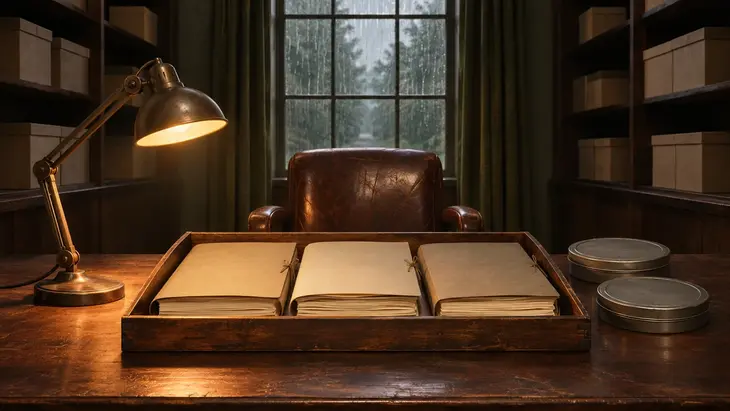
The archive preserves materials by Brian Aldiss, Ian Watson and Sara Maitland, among other documents whose authorship is not always identified with the same degree of certainty. The final screen story credit goes to Watson; the screenplay credit, to Spielberg. These credits identify responsibilities for the work produced without erasing the earlier preparatory work.
Designing a world and working out how to film it
The project had to make a childlike artificial character believable. This need affected both the portrayal and the organisation of the work. The design and effects planned for A.I. distinguishes conceptual drawings, production studies and methods actually used in the 2001 film.
Chris Baker, also known as Fangorn, is part of that continuity between preparation and production. However, the existence of earlier designs does not mean that all the sets and effects in the feature film can be attributed to Kubrick. The film had its own team and decisions made during its production under Spielberg.
The materials on screenplay development should not be read as images ready to be filmed either. A narrative proposal may call for a visual solution that is still open, while a drawing may prompt changes to the story. The relationship between writing and design was a working process, not a chain in which each stage was definitively closed before the next began.
A continuity that does not erase Spielberg’s authorship
Spielberg directed A.I. and wrote the screenplay for the film released in 2001. Kubrick had spoken with him about making it before his death in 1999. The relationship between the two in A.I. should be studied through testimony, materials and credits, not through an intuitive division between supposedly cold scenes and supposedly sentimental ones.
The adaptation also draws on a wider network of sources, with the figure of Pinocchio among the references considered during development. The work with literary sources makes it possible to examine how a story can broaden its scope without all its elements coming from the original tale. Identifying a reference does not mean attributing every later appearance to a single collaborator.
There is no version filmed by Kubrick that can be compared shot by shot with Spielberg’s. What exists is an earlier development and a later production related to it. Keeping that distinction in view makes it possible to study the collaboration without turning A.I. into a film directed by someone who never got to shoot it.
References: Brian Aldiss, Supertoys Last All Summer Long (1969). University of the Arts London, Stanley Kubrick Archive, A.I., SK/18/3. Amblin, A.I. Artificial Intelligence (2001) film information and credits. Ian Watson, Plumbing Stanley Kubrick. Jan Harlan, 2001 interviews.